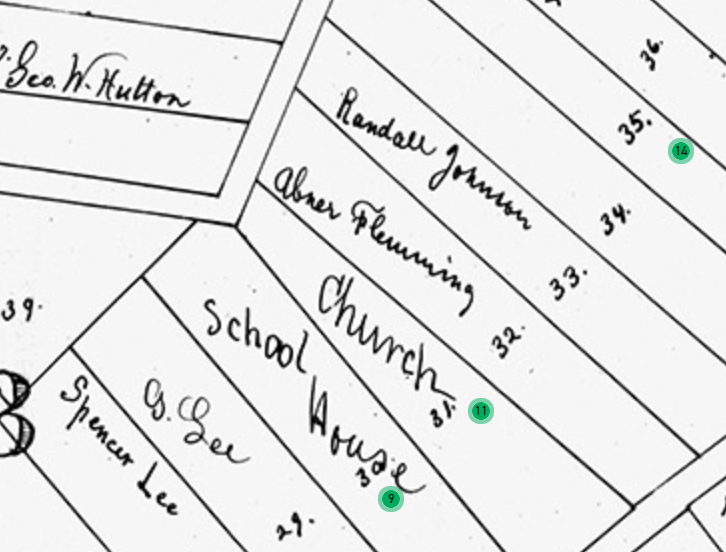
When the first settlers at Barry Farm-Hillsdale began building their houses, they also felt the need to build a school and church for their community. Religion had always played a major role in lives of enslaved African Americans. There was a great desire to have a place in the community where the residents could worship freely. However, education for the most part had been something they had not had access to. The community recognized that education was a crucial ingredient for the well-being and prosperity of this settlement, and the desire to acquire formal education for the newly freed people was at the top of their "wish list".
In October 1867, the Freedman's Bureau hired some of the residents to build the first school in the community. If you were paying attention to the 1867 Barry Farm map shown earlier, that school was built two lots away from Dabney's lot. It was called Howard School. It was also unofficially named Mt. Zion School by the community, after the name of the hill on which it stood.
The name "Mt. Zion" answered another question that I had. This was the issue: I noticed that on the original map of 1867, the street on the north border of Dabney's property had no name on it. The street on the southern border did show a name, "Pomeroy". In the 1880 census, this previously un-named street on the north boarderd was noted as "Mt. Zion St". We know this because in the census records, often the census-taker would vertically
write in the margins, the name of the street on which the residents that were being interviewed lived. In this case, the census-taker wrote "Mt. Zion Street." When we look at the 1900 census, the name in the margin is recorded is "Douglass Ave". This we now know as Douglass Place. No longer is there a Douglass Ave. So the current Douglass Place was "Mt. Zion St.", where Mt. Zion School was located, as we learn from other records. This explains the unofficial name that the residents gave the school, Mt. Zion school. In short, today there is no "Mt. Zion St." It is Douglass Pl.
The schoolhouse was 2 lots away from Dabney. It was described as being a plain building about 70 X 25 feet with an "A" roof. It was similar in construction as one of the houses in the area. It opened in 1868 and quickly outgrew its capacity. The Freedman's Bureau provided the materials and the local residents built it. Dabney was listed as a "laborer" in some census records and then as a "paver' in other records. Perhaps he also had a hand in the construction of this building.
Even more interesting, looking at the 1867 Barry Farm map, we see that between the school and Dabney's property, there was a church. He lived right next door to what was the first church in the Hillsdale community. It was called (you guessed it) Mt. Zion AME Church. Churches were a central part of community life. They also served as community centers and provided meeting space. Ministers provided leadership and voiced residents' demands and concerns. See the locations of the first school (Howard School, aka. Mt. Zion School) and church (Mt. Zion AME Church) below. Note Dabney's property location (lot 32).